


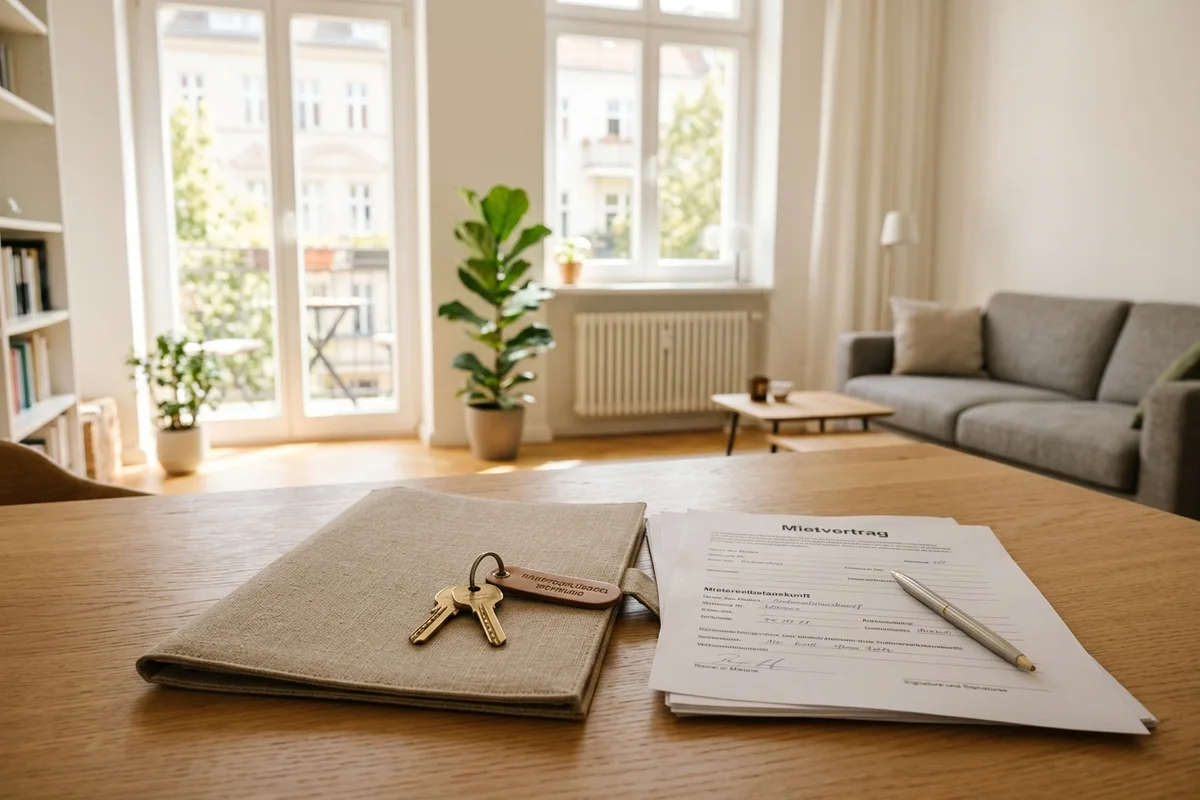
One of the first problems you may run into when looking for an apartment in Germany is SCHUFA.
The landlord asks for it.
You have only just arrived in Germany.
So you obviously do not have years of German banking and credit history behind you.
That was our situation when we moved to Düsseldorf.
We were still able to provide a SCHUFA document and rented our first apartment through ImmobilienScout24 by submitting it together with our employment and income documents.
The important point is this:
Being new to Germany does not automatically mean you cannot rent an apartment.
But the rest of your application needs to make sense.
Quick answer: Can you rent in Germany without an established SCHUFA history?
Yes.
A SCHUFA report is commonly requested by German landlords, but it is not the only way to demonstrate that you can reliably pay the rent.
Germany’s official Make it in Germany portal specifically notes that newcomers arriving from abroad may sometimes use alternatives such as a reference from their home-country bank or a guarantee from someone in Germany.
If you do not have payslips yet, an employment contract can also help demonstrate your expected income.
The landlord ultimately decides which documents they are willing to accept.
Our experience renting our first apartment in Düsseldorf
We rented our first German apartment in Düsseldorf.
We found it through ImmobilienScout24.
The landlord requested SCHUFA.
Even though we had no long German financial history at the time, we were able to obtain the document and include it in our application.
Our application included:
- SCHUFA
- employment contract
- payslips
- proof that we could cover the required deposit
For us, no single document won the apartment.
The overall application mattered.
There is also an important distinction between having only a short German credit history and having negative SCHUFA information.
Those are not the same situation.
What is SCHUFA?
SCHUFA is one of Germany’s main credit-information systems.
Banks, telecommunications companies and other businesses may use SCHUFA information when assessing financial risk.
Landlords also commonly request a SCHUFA document when choosing tenants.
The system changed significantly in 2026.
Since March 17, 2026, the new SCHUFA score uses a scale from 100 to 999 and is based on 12 published criteria. According to SCHUFA’s official scoring documentation, these include factors such as:
- payment defaults
- age of your oldest bank relationship
- age of your oldest credit card
- how long you have lived at your current address
- recent bank-account and credit-card applications
- instalment loans
That context matters for newcomers.
Someone who has only recently moved to Germany naturally cannot have a 10-year German banking history.
No SCHUFA history is not the same as bad SCHUFA
This distinction matters.
Having limited data because you have only recently arrived in Germany is one situation.
Having unpaid debts or negative records is another.
If you are a newcomer, it can therefore help to explain your situation clearly and support your application with evidence of employment and income.
What should you include in your rental application?
1. Employment contract
If you have not received several German payslips yet, your employment contract can be one of your strongest documents.
It can demonstrate:
- your employer
- your start date
- your expected salary
Germany’s official newcomer guidance specifically mentions employment contracts as useful when payslips are not yet available.
2. Payslips
If you have already started working, include the payslips you have.
For a landlord, reliable income is an important part of assessing whether the rent is affordable.
3. SCHUFA information
Even if you are new to Germany, check what information SCHUFA already holds about you.
The 2026 system now provides free digital access to your score and underlying information through SCHUFA’s own account options, as detailed by consumer organization Verbraucherzentrale.
You can also exercise your GDPR data-access rights to see the personal data stored about you.
The often-repeated claim that you are only entitled to one free SCHUFA request per year is outdated and too simplistic.
4. A reference from your bank abroad
Germany’s official Make it in Germany portal suggests that a reference from your bank in your previous country may be accepted in some cases.
There is no guarantee that an individual landlord will accept it.
But for a newcomer with limited German history, it may strengthen the application.
5. A guarantor
A guarantee, or Bürgschaft, may help in some situations.
For example, a person in Germany with sufficient financial standing may agree to guarantee the rent.
A guarantee creates a serious financial obligation for the guarantor, so everyone involved should understand exactly what they are signing.
Does paying a larger deposit replace SCHUFA?
No.
A rental deposit and SCHUFA serve different purposes.
The deposit provides security for certain obligations under the tenancy.
SCHUFA provides information related to creditworthiness and payment history.
In our own Düsseldorf application, being able to pay the deposit did not remove the request for SCHUFA.
How we found the apartment
We found our apartment through ImmobilienScout24.
In competitive German cities, attractive apartments can receive many applications.
One practical lesson from our experience is to prepare your documents before you find the perfect listing.
A clean application folder might contain:
- identification
- income evidence
- employment contract
- SCHUFA
- additional references where relevant
That means you can respond quickly when a suitable apartment appears.
At the same time, do not send more sensitive personal information than the landlord genuinely needs.
What I would do if I moved to Germany again today
I would:
- Prepare my employment and income documents before arriving.
- Complete address-registration steps as early as possible. If you are planning your arrival steps, read our guide on 5 Essential Things to Do After Moving to Germany.
- Open my German bank account.
- Check what SCHUFA information already exists about me.
- Prepare one organised rental-application package.
- Explain clearly that I am new to Germany if my SCHUFA history is limited.
- Support the application with employment and income evidence rather than trying to hide the lack of German history.
What changed with SCHUFA in 2026?
The old percentage-based model has been replaced by a new score.
The new score:
- ranges from 100 to 999
- uses 12 published criteria
- is designed to be easier for consumers to understand
A higher score generally represents stronger assessed creditworthiness.
But SCHUFA does not decide whether you get the apartment.
The landlord does.
Do not treat the score as an automatic apartment-approval number.
What helped us get our first apartment?
In our case, four elements worked together:
- Stable employment
- Employment contract
- Payslips
- SCHUFA documentation
I cannot claim that the same combination guarantees an apartment in Düsseldorf or elsewhere.
It does not.
But having only a short German financial history should not stop you from applying.
The real question your application needs to answer is:
Can this person reliably afford and pay the rent?
Build your application around that.
FAQ
Can I get SCHUFA if I have just moved to Germany?
If SCHUFA already has information linked to you, you can check the data it holds. Newcomers may naturally have much less German financial history than long-term residents.
Is SCHUFA legally required to rent an apartment in Germany?
No. It is not a universal legal requirement for every rental contract. However, landlords commonly request it when assessing applicants.
Can an employment contract replace SCHUFA?
Not exactly. It answers a different question. But for a newcomer with limited German history or no payslips yet, it can provide important evidence of future income.
Can I only get a free SCHUFA report once per year?
That common rule of thumb is outdated. Current GDPR access rights and SCHUFA’s digital account options provide broader ways to access your stored information.
What documents do German landlords normally ask for?
Requirements vary, but common documents include identification, payslips, income evidence, SCHUFA, a tenant self-disclosure form and, for newcomers, potentially an employment contract or guarantor.