



Transparency & Referral Disclosure: This article contains my personal Wise referral link. If you choose to sign up or send money through this link, I may receive a referral credit in accordance with Wise’s current program terms. This does not influence my editorial independence, objective comparison, or real experience shared since 2018. I am not a financial, tax, or legal adviser; this guide reflects genuine user experience and verified 2026 market data.
From the moment you move to Germany, sending money to Turkey—whether supporting family, managing investments, or paying local bills—quickly becomes an essential monthly task.
At first glance, logging into your German banking app and initiating an international wire transfer seems like the obvious choice. However, once you examine traditional bank fee schedules and foreign exchange rates, you quickly realize that the visible transfer fee is only the tip of the iceberg.
Hidden exchange rate markups, intermediary correspondent bank fees, and conversion spreads can substantially erode the final Turkish Lira amount that reaches the recipient’s bank account.
I have lived in Germany (Düsseldorf) and regularly transferred money to Turkey using Wise since 2018. Over the years, I have sent amounts ranging from €1,000 to €3,000 directly to my own Turkish bank accounts at Garanti BBVA and Enpara, funding them via SEPA bank transfers and debit cards. In this guide, I combine my real-world transaction data, verified screenshots, and current 2026 provider rates to help you find the most cost-effective and dependable way to send money from Germany to Turkey.
1. Never judge a provider solely by the transfer fee: Services advertising “0 € commission” often hide a 1.5% to 3% markup in the exchange rate. The only metric that matters is: “How much net Turkish Lira (TRY) will actually arrive in the recipient’s bank account?”
2. Wise is fully operational for transfers to Turkey: While local 2023 regulations restricted residents in Turkey from holding multi-currency balances, German and European Wise users can send funds to any Turkish bank IBAN without issue. The recipient does not even need a Wise account.
3. 26 October 2026 Comparison Result: In a live test sending €1,000 via standard bank transfer, Wise delivered 55,396.10 TRY by using the real mid-market exchange rate. Traditional German banks, due to wide exchange markups and SWIFT processing fees, delivered only ~53,100 to 53,500 TRY.
Don’t Compare Fees Alone — Compare How Much TRY Actually Arrives
The single most common mistake expats make when transferring money abroad is focusing entirely on the headline fee: “How many Euros does the transfer cost?”
In international remittances, there are two distinct costs:
- The Upfront Transfer Fee: The transparent fixed or percentage service fee charged by the platform.
- The Exchange Rate Markup: The difference between the mid-market exchange rate (the real rate you see on Google or Reuters) and the unfavorable rate the provider gives you.
For instance, a provider might advertise a low €1.99 transfer fee. However, if the real mid-market rate is 1 EUR = 55.78 TRY and the provider only offers you 54.80 TRY, you silently lose 980 TRY (approx. €17.50) on a €1,000 transfer. The true cost of that transfer is therefore nearly €19.50, not €1.99.
That is why fair comparison requires looking at one figure: the exact, guaranteed Turkish Lira amount credited to the recipient’s bank account.
€1,000 Comparison Guide: Wise, Transfer Services and Banks
There is no permanently fixed “cheapest provider” in international remittances. Currency exchange rates fluctuate by the second, upfront fees differ, and introductory promotions expire. To evaluate transfer options accurately and avoid marketing traps, you must evaluate every transfer against six essential criteria:
| Comparison Factor | Why It Matters | Key Differences Across Providers |
|---|---|---|
| 1. Amount Sent | Larger transfer amounts magnify the hidden cost of exchange rate markups. | For a €100 transfer, a €2 fee matters most; for €1,000 or €2,000, a 2% exchange rate spread represents a massive hidden loss. |
| 2. Funding Method | How you deposit the EUR in Germany dictates the initial processing fee. | SEPA domestic bank transfer from your German account is generally the cheapest option. Debit or credit cards offer immediate speed but add payment gateway fees. |
| 3. Upfront Transfer Fee | The explicitly displayed service fee charged by the provider. | Some providers advertise “Zero Fee” transfers but quietly recoup their profit by offering an inferior, marked-up exchange rate. |
| 4. Applied Exchange Rate | The spread between the interbank mid-market rate and the rate quoted to you. | Wise uses the real mid-market exchange rate with an upfront fee; traditional banks and legacy remittance operators typically embed a 1.5% to 3.5% hidden margin in the FX rate. |
| 5. Net Recipient Amount (TRY) | The single most decisive metric to evaluate across all services. | Instead of juggling fees and exchange percentages, compare the exact, guaranteed Turkish Lira amount that will be credited to the Turkish bank account. |
| 6. Delivery Speed | The time required for funds to become available in the recipient’s account. | Modern digital platforms often deliver within minutes to several hours; traditional correspondent SWIFT bank transfers typically take 2 to 5 business days. |
My Approach to Finding the Cheapest Option: The cheapest option can change with the exchange rate, fee and funding method, so I compare the final TRY amount the recipient will receive before confirming a transfer. In my ongoing experience since 2018, transparent digital providers that apply the mid-market rate without an embedded currency markup consistently deliver more Turkish Lira for transfers of €1,000 and above than traditional banks charging exchange spreads.
Check today’s live Wise EUR → TRY rate →
How I Send Money from Germany to Turkey: My Wise Experience Since 2018
I have lived in Düsseldorf, Germany, and have used Wise continuously for Germany-to-Turkey transfers since 2018.
Over these years of routine usage, several practical insights have shaped how I manage my transfers:
1. Transferring Primarily to My Own Turkish Bank Accounts
Like many expats, most of my transfers are sent to my own accounts in Turkey—specifically at Garanti BBVA and Enpara. Because the name on my German Wise account matches the name on my Turkish bank account exactly, my transfers have processed seamlessly without compliance holds or identity re-verification hurdles.
2. Experience with €1,000, €2,000, and €3,000 Amounts
I have regularly transferred smaller sums as well as larger tranches of €1,000, €2,000, and €3,000. As transfer sums increase, traditional bank exchange spreads of 2% to 3% can cost you hundreds of Euros. Using a provider that quotes the transparent mid-market rate becomes vastly more important as the amount grows.
3. Funding Methods: German SEPA vs. Credit Card
In my experience, funding via SEPA bank transfer from your German bank is the most economical method. Wise provides you with German account details, and you make a standard domestic transfer from your online banking app. For urgent situations, funding with a debit or credit card takes seconds, though it carries a slightly higher processing fee.
My Real €2,000 Wise Transfer: How Long Did It Take?
Online transfer guides frequently make exaggerated claims like “Transfers are always instant” or “It always takes 2 days.” To show what a real transaction looks like, here is an actual transaction record from my personal Wise account for a €2,000 transfer sent to my Turkish bank account:
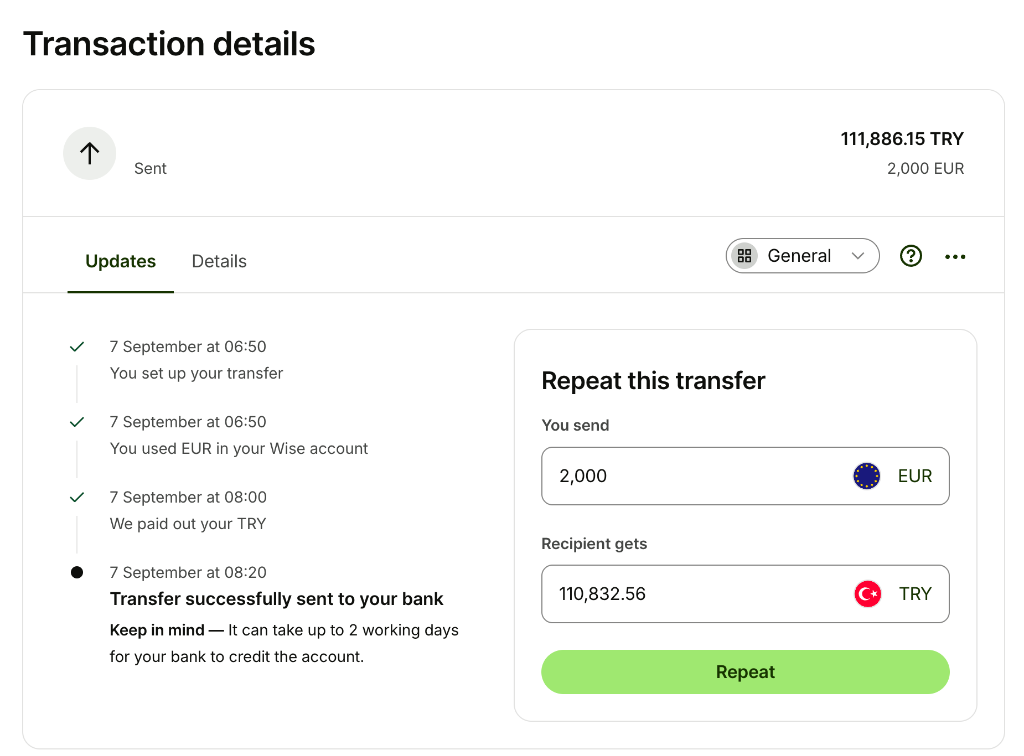
Here is how the timeline played out:
- 06:50: I set up the transfer in the Wise app.
- 06:50: EUR funds in my Wise account were allocated for the transaction.
- 08:00: Wise notified that the Turkish Lira payout was processed (We paid out your TRY).
- 08:20: Wise confirmed the funds were successfully dispatched to my Turkish bank (Transfer successfully sent to your bank).
In this particular transaction, the Wise-side processing took approximately 1 hour and 30 minutes. In my general experience since 2018, transfers usually land on the same day, frequently within a few hours. However, as noted on the screen, receiving Turkish banks can take additional time to credit the account depending on operating hours and system volume. This is why a 90-minute completion should be viewed as a real example, not an official service-level guarantee.
Clarification on the Figures: The 111,886.15 TRY shown at the top of the screenshot was the actual historical amount credited for that specific €2,000 transfer. The box on the right represents a later repeat-transfer quote generated by Wise; the two figures must not be confused.
How to Send Money to a Turkish IBAN With Wise (Step-by-Step)
If you have never used Wise before, the process is straightforward:
- Create an Account: Register online or download the Wise app, completing your initial identity verification.
- Set Your Amount: Enter the Euro amount you want to send. Wise instantly displays the fee and the guaranteed Turkish Lira amount your recipient will receive.
- Enter Recipient Details: Enter the recipient’s full legal name and their 26-character Turkish IBAN starting with TR. If sending to yourself, select “My own account.”
- Choose Your Payment Method: Fund the transfer using a SEPA bank transfer from your German bank, or pay via debit card.
- Track the Transfer: Follow real-time progress updates directly inside the app until the funds reach the Turkish bank.
Does the Recipient in Turkey Need a Wise Account?
No, absolutely not.
Your recipient (whether family, a friend, or yourself) does not need to register with Wise or download the app. Wise operates through licensed partner banks in Turkey (such as Fibabanka and Birleşik Fon Bankası) to disburse funds. The money arrives as a standard domestic EFT/FAST transfer directly into the recipient’s regular bank account at Ziraat, Garanti, İş Bankası, Enpara, Akbank, or Yapı Kredi.
Does Wise Still Work for Germany-to-Turkey Transfers?
You may have heard online rumours that “Wise is restricted or banned in Turkey.” This misconception arises from a misunderstanding of local 2023 Turkish banking regulations.
Here is the crucial distinction:
- For Residents in Turkey: Users with a Turkish residential address can no longer hold foreign currency balances in Wise or order a Wise payment card.
- For Residents in Germany / Europe: If your Wise account is registered to your European address, there are zero restrictions on sending EUR to any Turkish bank account in TRY. The service is 100% operational and officially supported.
Can I Send Money to My Own Turkish Bank Account?
Yes. I have routinely sent money to my own Turkish bank accounts since 2018.
Keep these sensible practices in mind:
- Ensure your name on Wise matches your official Turkish bank registration letter-for-letter.
- Add a clear reference in the payment description (Verwendungszweck), such as “Personal savings transfer / Ersparnisse”, to keep your financial records organized.
- Transferring post-tax savings between your own accounts in Germany and Turkey does not automatically trigger income tax, but if you have complex residency or tax questions, consulting a certified tax adviser is always advisable.
Large Transfers and German Reporting Rules (AWV-Meldepflicht)
When sending substantial sums abroad from Germany, expats often encounter questions regarding reporting obligations to the German central bank under Section 67 of the Foreign Trade and Payments Ordinance (§ 67 AWV – Außenwirtschaftsverordnung).
For German residents, certain cross-border payments may be subject to AWV reporting depending on the current threshold and applicable exemptions. However, the exact rules and exemptions set by the Deutsche Bundesbank clarify the practical requirements:
- €50,000 Threshold (Effective 1 January 2025): The historical reporting limit of €12,500 was officially raised to €50,000 on 1 January 2025 under the Fourth Bureaucracy Relief Act (BEG IV). Routine transfers below €50,000 do not require any reporting.
- Exemption for Transfers Between Own Accounts: Importantly for my own use case, the Deutsche Bundesbank states that transfers between a person’s own accounts (reine Kontoüberträge zwischen eigenen Konten) are exempt from this reporting requirement. Shifting funds between your own German bank account and your own bank account in Turkey represents an internal asset reallocation rather than an economic exchange with a third party.
- Nature of the Requirement: Even where a report is mandatory, it is strictly a statistical reporting mechanism for Germany’s balance of payments, not a tax, restriction, or approval process. Automated reminder notes on bank statements stating “AWV-Meldepflicht beachten” are standard bank-system disclaimers and do not override statutory exemptions.
When Wise Is Not the Best Option
While Wise is our primary recommendation for digital bank-to-bank transfers, other services may be necessary in specific scenarios:
- Cash Pickup Required: If the recipient does not have a Turkish bank account and needs physical cash at a local branch, services like Western Union or MoneyGram (via PTT branches) are mandatory.
- First-Transfer Promotional Rates: Platforms like Remitly occasionally offer zero-fee or boosted exchange rates on your very first transfer, which can temporarily beat standard pricing.
- Commercial Trade & Letters of Credit: For corporate imports requiring bank-backed trade financing, traditional corporate banks remain necessary.
My Verdict: How I Manage My Transfers
If your priority is transparent pricing, the real mid-market exchange rate, and fast account-to-account delivery, Wise remains my go-to service for sending money from Germany to Turkey.
By funding transfers via SEPA from my German bank account and sending directly to my accounts at Garanti BBVA or Enpara, I eliminate surprise fees, avoid hefty currency spreads, and can monitor the entire transfer live from my phone.
For more insights on settling your finances after moving, check out our guide on 5 Essential Things to Do After Moving to Germany.
Set up your Wise transfer to Turkey →
Frequently Asked Questions (FAQ)
What is the cheapest way to send money from Germany to Turkey?
The cheapest option can change with the exchange rate, fee, and funding method at the time of your transfer, meaning no single provider is permanently the cheapest. The most reliable method is to compare the final, guaranteed Turkish Lira amount that reaches the recipient’s bank account. Services that use the transparent mid-market exchange rate with an upfront fee (like Wise) consistently deliver more TRY than traditional banks charging 2% to 3% exchange rate spreads.
Can I send money directly to a Turkish IBAN?
Yes. You can send funds directly from your German account to any 26-character Turkish IBAN starting with TR. The money is deposited as domestic currency in the recipient’s bank account.
Does the recipient in Turkey need a Wise account?
No. The recipient only needs a standard Turkish bank account (in TRY). The funds arrive as a local bank transfer directly into their existing account.
Does Wise still work for transfers to Turkey?
Yes. Sending money from Germany or Europe into Turkish bank accounts is fully operational. The 2023 restrictions only affected residents living in Turkey regarding holding foreign currency balances within Wise.
How much does it cost to send €1,000 from Germany to Turkey?
Total cost depends on the real-time exchange rate, the payment method chosen (SEPA bank transfer vs. card), and the provider’s fee schedule. Digital specialists using mid-market exchange rates charge a transparent upfront fee of a few Euros, while traditional banks impose higher wire fees and an additional 2% to 3% currency markup.
How long does Wise take from Germany to Turkey?
In my experience since 2018, transfers typically arrive the same day, often within a few hours. In a documented €2,000 transfer, Wise processed and sent the funds to the Turkish bank in about 1 hour and 30 minutes, though receiving banks can occasionally take longer.
Can I send money to my own Turkish bank account?
Yes. As long as your name matches on both accounts, you can transfer post-tax savings to your own accounts in Turkey without issue.
Is Wise safe to use in Germany?
Yes. Wise is licensed and regulated in the European Economic Area by the National Bank of Belgium (NBB), and customer funds are safeguarded in separate tier-one banking institutions.
Are there reporting requirements for large transfers from Germany?
Under Section 67 AWV, certain cross-border payments may require statistical reporting to the Deutsche Bundesbank, but the threshold was raised to €50,000 as of 1 January 2025. Crucially, the Deutsche Bundesbank explicitly exempts transfers between a person’s own accounts (reine Kontoüberträge) from this reporting requirement. Where reporting is required for third-party transfers, it is purely statistical and carries no tax liability.